 linger
On this page
You remember a picture, not its filename
A black, stone-like business card used to be the first result. We added automatic descriptions to help search understand more about the library. The card fell to thirteenth.
The image had not changed. The query had not changed. What changed was how much authority we gave the new text. That failure became a useful way to think about Recall: every extra clue can help the right image, but it can also promote the wrong one.
“Something like a dragon. Red. Maybe breathing fire. ASCII elements? A poster.” This was another real development query, translated from Chinese. It is a description of something already seen, with some details remembered and others uncertain. We want Recall to work with those fragments, without requiring a note or a tag on every image first.
Between October 19 and 31, we tested local models, source clues, automatic descriptions and text embeddings. Here is what we learned from search regressions, what we rolled back, and how we balanced candidate retrieval.

What you can use today
In Linger 0.5.2, core search uses your saved text, notes, tags and filters. Experimental on-device image recall needs a separately prepared runtime and model, which are not bundled with the desktop download. Local recall and external model connections are both optional and off by default.
Once local recall is configured and indexed, it can match a description to images without prior manual tags. With an external model connection enabled, Linger can also send up to 24 candidate previews and their saved records to the chosen provider for review.
The later sections explore text embeddings and 48-image model review in separate experiments outside the 0.5.2 search path. In the app, “Load more” displays more results from the existing search session.
What counts as finding an image?
The later experiments searched a copy of a personal library containing 145 valid images. We fixed 80 queries: 76 with a designated target, covering 25 different images, and four negative cases. Several queries describe the same image in different words.
We wrote most queries while looking at the target images; four dragon-related queries came from the user. Reusing those questions gave us a consistent way to spot regressions as the code changed.
We measured two stages: getting the intended image into the candidate batch, then ranking it through optional model review. Top-24 coverage counts queries whose target appears among the first 24 candidates. Model review used a smaller fixed set of six targets and two queries for absent images.
A workable local starting point
Our October 19 comparison used a separate 48-image sample: the pinned DigUp 0.6.1 implementation and a SigLIP 2 Base/256 implementation.
| Measure | DigUp | SigLIP 2 |
|---|---|---|
| Target first, 32 queries | 29/32 | 25/32 |
| Target in first five, 32 queries | 32/32 | 31/32 |
| Target first, 24 queries for newly added targets | 22/24 | 21/24 |
For the newly added targets, the first-place difference was just one query. DigUp’s Chinese ranking, measured search memory use and existing integration made it a workable starting point. SigLIP 2 was faster in warm queries and repeated full indexing. Neither won every comparison.
Follow-up searches also exposed a problem after ranking: a relevant footer-design image could rank well and still be removed by a relative-score threshold. For two photographic memories, we could not confirm the targets were even in the sample. Both failures mattered more than declaring a model the winner.
“Maybe from Twitter” is not a filter
“Maybe from Twitter” is a clue. “Only from Twitter” is a restriction. We kept the full visual description for image matching and used saved source records to handle that distinction. A missing source record does not establish that an image came from somewhere else.
Not every additional clue helped. A pixel-color bonus raised top-five hits from 29/36 to 31/36 in the development group, but lowered first-place hits from 24/36 to 23/36: a more obviously colored wrong image could overtake the target. We removed it.
Combining the full query with a second, source-stripped image query also failed to improve first-place or top-five hits in the other 36-query group, and lowered three target ranks. We removed that change too.
The retained source rules moved first-place hits from 24/36 to 25/36 in the development group; the other group stayed at 24/36. The useful correction was small: uncertain memory no longer became an accidental exclusion.
More descriptions made the ranking worse
Automatic descriptions could name details the image model missed. We analyzed 24 images—12 targets and 12 distractors—using their images and ordinary saved records, without the test queries or answer labels. Search still covered all 145 images.
We then put text matches ahead of image candidates. First-place hits fell from 50/76 to 39/76; top-five hits fell from 62/76 to 47/76. Top-24 coverage stayed at 66/76. The targets were still in the pool, but useful early results were harder to reach.
Other generated descriptions also contained “black.” Those partial matches crowded ahead of the stone-like card. We had treated one matching detail as if it explained the whole memory.
The repair combined stricter text eligibility with reciprocal rank fusion (RRF), a method introduced by Cormack, Clarke and Büttcher in 2009. It combines positions in result lists rather than their raw scores. The eligibility rule decides which text matches are strong enough to participate.
Together, those changes returned the business card to first place and restored top-five hits to 62/76, recovering the earlier ranking. Because we changed eligibility and fusion together, this result measures their combined effect.
The missing image was outside the review batch
A purple-and-orange collage website appeared at position 28 for one query. The first model-review batch contained 24 candidates. No improvement to the reviewer could make it choose an image it had not received.
We tried reviewing the next 24 candidates too. Across six fixed targets, final top-five hits rose from 5/6 to 6/6. But at eight images per request, the request count doubled from three to six. More images also added distraction: in a later experiment, the collage ranked first after reviewing 24 and second after reviewing 48.
An initial run with the default xhigh reasoning setting exceeded our 180-second execution budget. We completed these comparisons using gpt-6-astra with low reasoning effort.
Shorter descriptions did not change the results
We rewrote the analysis prompt to focus on visible subjects, layout and the role of color, reduce redundant tags, and avoid guessing unreadable text. Machine observations remained separate from the collector’s own words.
Across the 24 analyzed images, average tag count fell from 16.4 to 7.2 and average description length from 285.0 to 121.4 characters. Some useful Chinese terms disappeared too. All 80 target-rank records stayed unchanged; top-24 coverage remained 66/76.
A clearer description was not enough. We still needed a way for search to use its meaning.
Bring one image forward without losing another
In an isolated copy, we encoded the existing machine descriptions, tags and OCR with the available local text encoder. No new analysis or manual tags were added. Only 24 of the 145 images had machine analysis, so the remaining images needed attention too.
The first version allowed text candidates to move forward while leaving the leading results alone. Top-24 coverage rose from 66/76 to 69/76. All three added hits described the same collage, moving from positions 28, 25 and 29 to position 9.
A pixel-giraffe poster without machine analysis paid for that change: one query moved from position 46 to 49. Top-48 coverage fell from 75/76 to 74/76. Helping the analyzed image had displaced an image without the new signal.
The next version admitted only stronger text matches and limited movement to the original 48-candidate pool. It preserved the leading results and the membership of that larger pool. Text could move an existing candidate forward, but could not introduce an outsider by evicting an image already inside.
Top-24 coverage stayed at 69/76; top-48 coverage returned to 75/76, bringing the giraffe back to rank 46. Across the fixed six-target review set, all six references placed in the top five results from the first batch.
| Stage | Top 1 | Top 5 | Top 24 | Top 48 |
|---|---|---|---|---|
| Before automatic analysis | 50/76 | 62/76 | 66/76 | 75/76 |
| Text matches first (rejected) | 39/76 | 47/76 | 66/76 | 75/76 |
| Guarded text + image fusion | 50/76 | 62/76 | 66/76 | 75/76 |
| Shorter analysis prompt | 50/76 | 62/76 | 66/76 | 75/76 |
| Text semantics (experiment) | 50/76 | 62/76 | 69/76 | 74/76 |
| Text semantics + protected pool (experiment) | 50/76 | 62/76 | 69/76 | 75/76 |
The engineering tradeoff is clear: stronger text matches can move forward within the original top-48 pool while its membership stays fixed. This cannot bring in a target from outside that pool, and positions within the first 24 can still change.
“It is not in your library” remains unresolved
One negative query described a blue rabbit playing a piano in a kitchen. A similarity ranking can still return a nearby color, object or composition. It ranks the available images; that ranking alone does not establish that the requested image exists.
Model review returned no matches for both absent-image queries, while the interface kept the local candidates available to browse. That leaves a product question: how should Recall present similar images when the specific one you remember may be missing?
We need more absent-target queries and actual interface tests before deciding when to say “no match,” when to show tentative results, and when to ask for another clue.
What changes as a library grows?
The experiments above cover 145 images. A collection of 20,000 raises three questions for a larger comparison.
Can the target survive more plausible alternatives? A fixed batch of 24 may become crowded when many references share a style. Tracking the target’s rank as similar images are added would show where that budget starts to fall short.
What does indexing cost on the Mac? First-time indexing and adding a few new images are different workloads. Both need measurements of time, peak memory and how responsive the app remains while they run.
Which extra clue helps when images look alike? Saved dates, sources and personal notes could help distinguish close matches. As with “maybe from Twitter,” an uncertain remembered date should remain a clue. Comparing new queries would help determine how much weight to give it.
Explore the ranking data
The attachments contain all 80 query rows from the six later ranking stages. Shared anonymous target IDs show when several queries refer to the same image.
Follow a target across the six columns to see where it moved, or recompute the coverage totals from its ranks. The downloads contain those target rankings and summaries; the original images, queries, full candidate lists and model-review outputs remain private. The data definitions explain each field and how the experiments were run.
- More information can worsen retrieval. Giving text priority reduced first-place hits from 50/76 to 39/76.
- The candidate batch limits what a reviewer can find. A target outside it cannot be selected from it.
- A gain needs a regression check. Text semantics helped one target image; protecting the larger pool recovered another.
The next useful milestone is seeing how Recall performs on new collections with references found from genuine memory.
Try it with a memory of your own
Start with a small collection. Without reopening one image, write what you remember and leave uncertain details uncertain. For a description that was never saved as text, check the local recall setup requirements first.
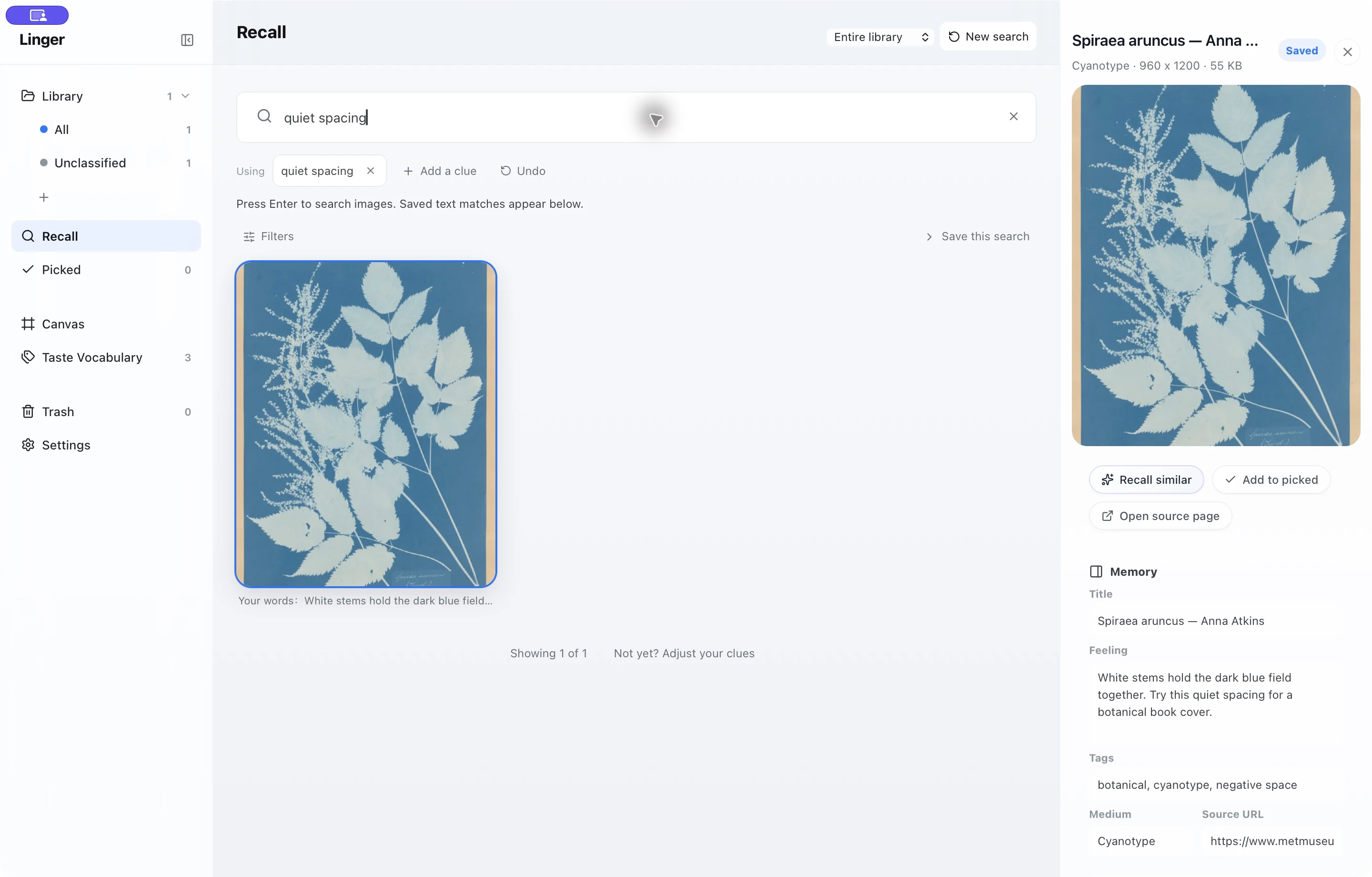
A note gives you another route when it contains the clue you remember. In the example below, “quiet spacing” retrieves a botanical reference through its saved Feeling note. This is ordinary saved-text matching with no model enabled.
Follow the first-reference walkthrough with an image of your own, or explore the curated sample in the browser demo. Then try a reference you have not opened recently, using whatever details stayed with you.